Notifications framework: Disputes
Notifications across the Disputes platform had drifted into overlapping reminders, missing next steps, and no clear outcome for the person reading them. I built a framework to streamline and prioritize push, SMS, and bell alerts, so each one has a purpose and points to what happens next. In under six months, products outside our platform team had picked it up, and it became the messaging framework for Disputes.
My role:
As the lead Content Designer, I worked with the product, the notifications team, data analysts, and their engineering partners from discovery to handoff. After handoff, I worked mainly with legal and localization.
Context and ask:
Disputes notifications reach both sides of a case: the customer who files it, and the merchant whose money is put on hold until an outcome is decided. They tell people what’s happening and when they need to act. While this is in the ideal world, today the notifications included SMS, push and bell alerts covering just 3 to 4 use cases. For example:
1. When a case is filed
2. When a case is in progress (no granular details, this would be a generic type)
3. When a case is closed.
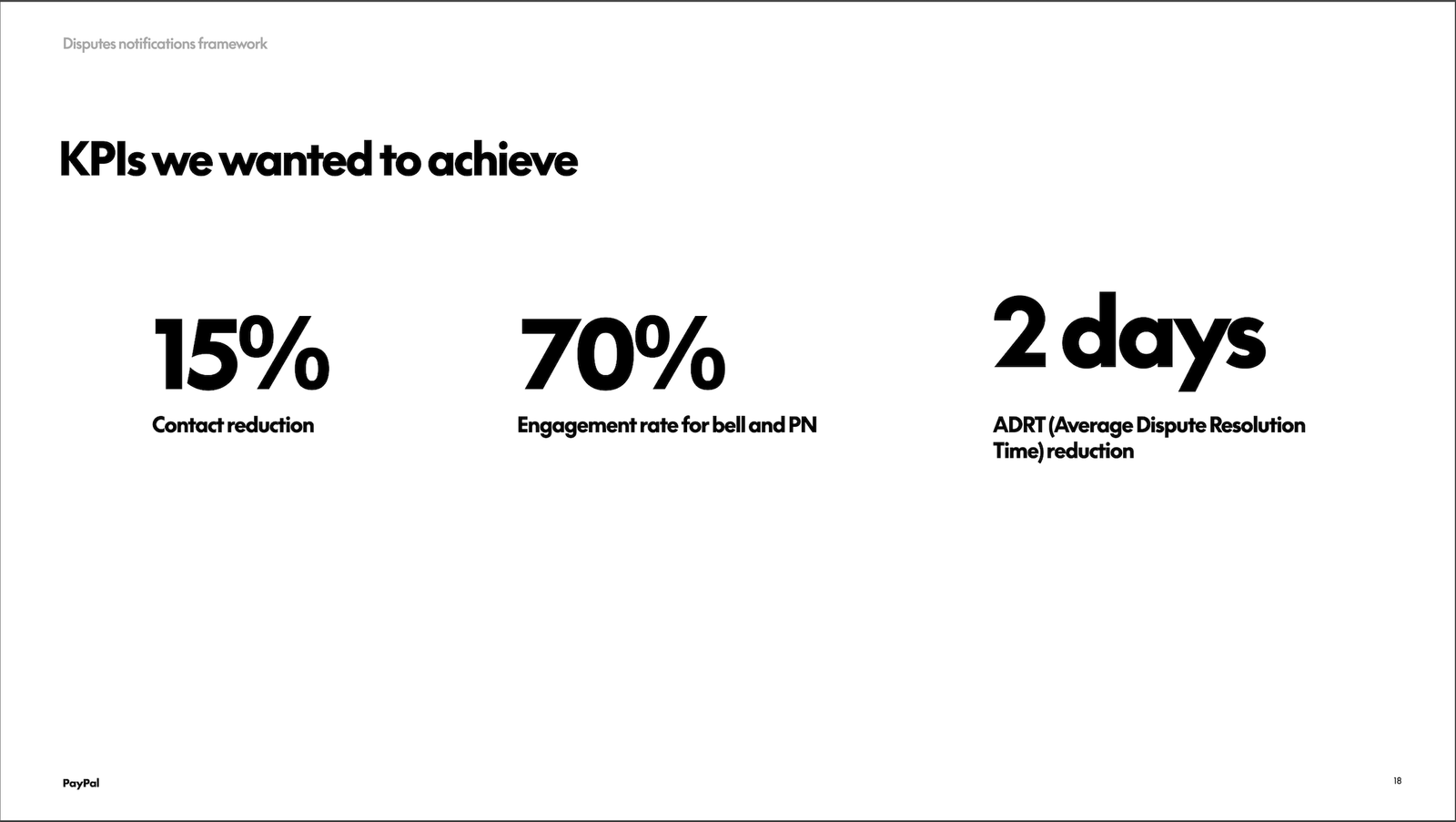
The ask was to ensure we notify our users and keep them informed and engaged so we reduce the contact rates and improve customer satisfaction.
Pain points:
The notifications were written one scenario at a time, by different teams, across three channels. We observed increased contact rates. In 80% of contacts, consumers wanted to know how their case was progressing, because we’d told them little or nothing.
For this purpose, product picked up 25 use cases spread across the dispute lifecycle to strengthen the outreach communication.
What we wanted to measure
The discovery phase:
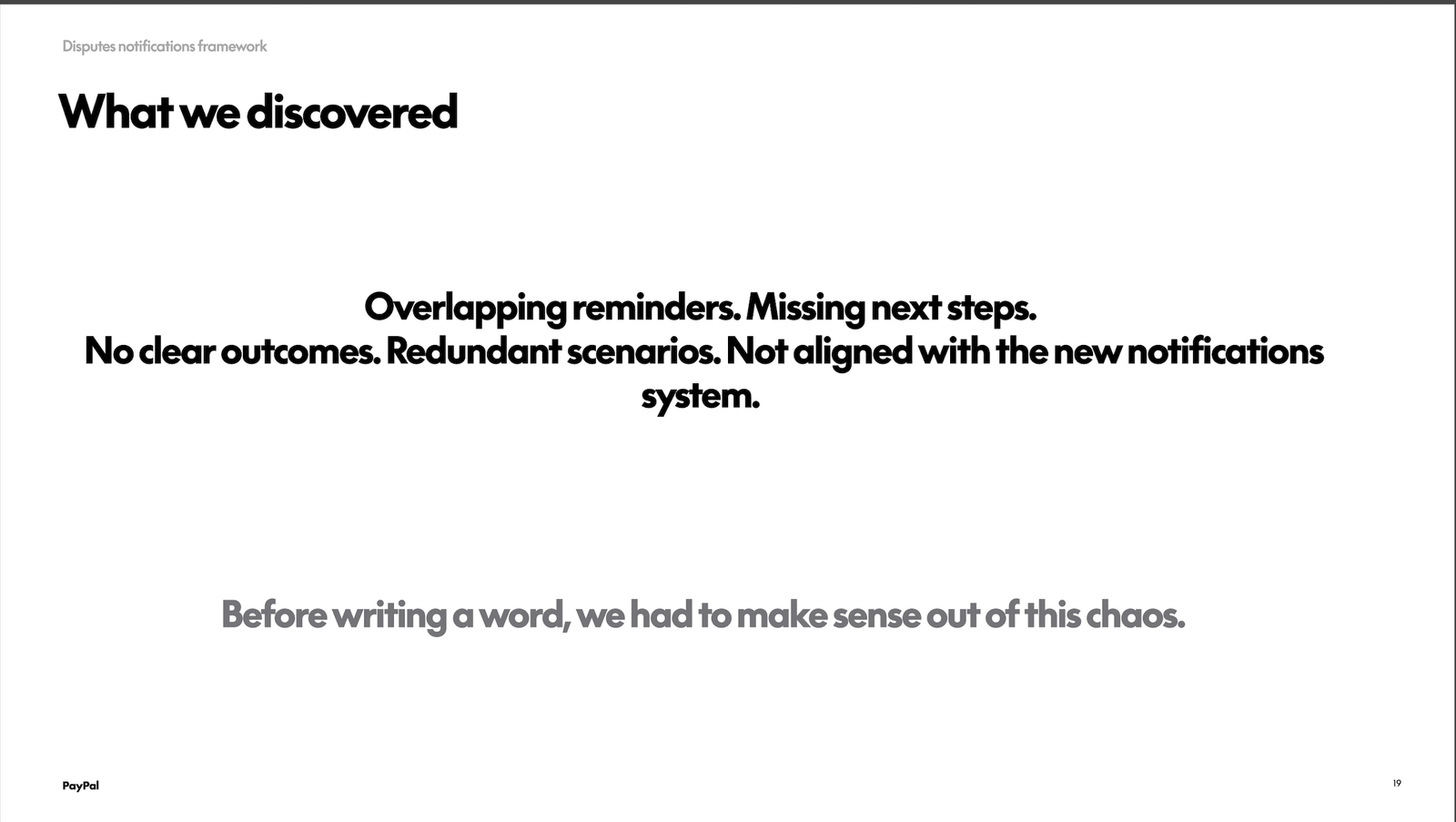
Product’s starting point was an AI-generated draft for every use case. Before working from it, I looked at what was already live. That’s where the overlapping reminders, missing next steps, and redundant scenarios surfaced.
Jobs to be done:
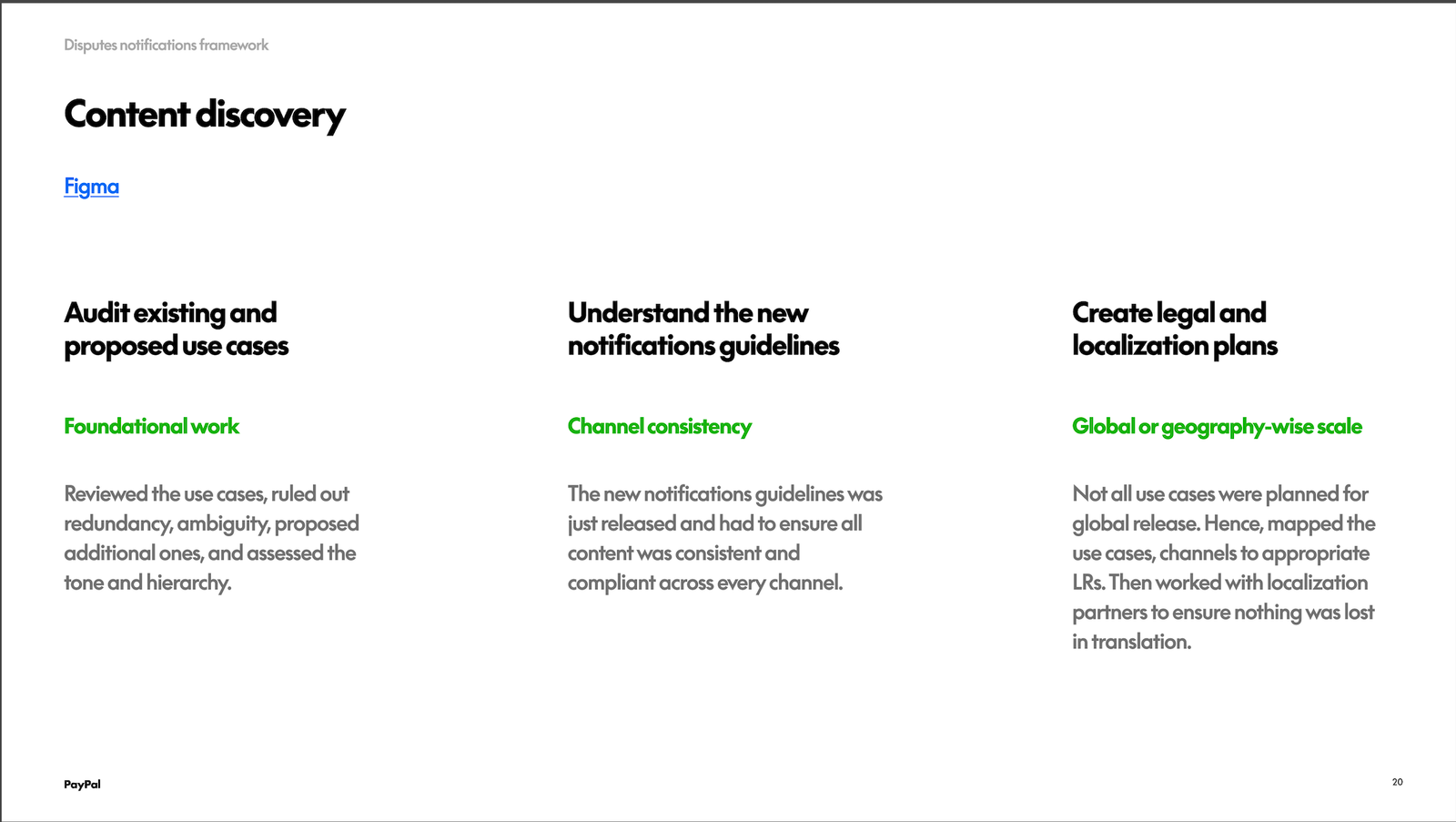
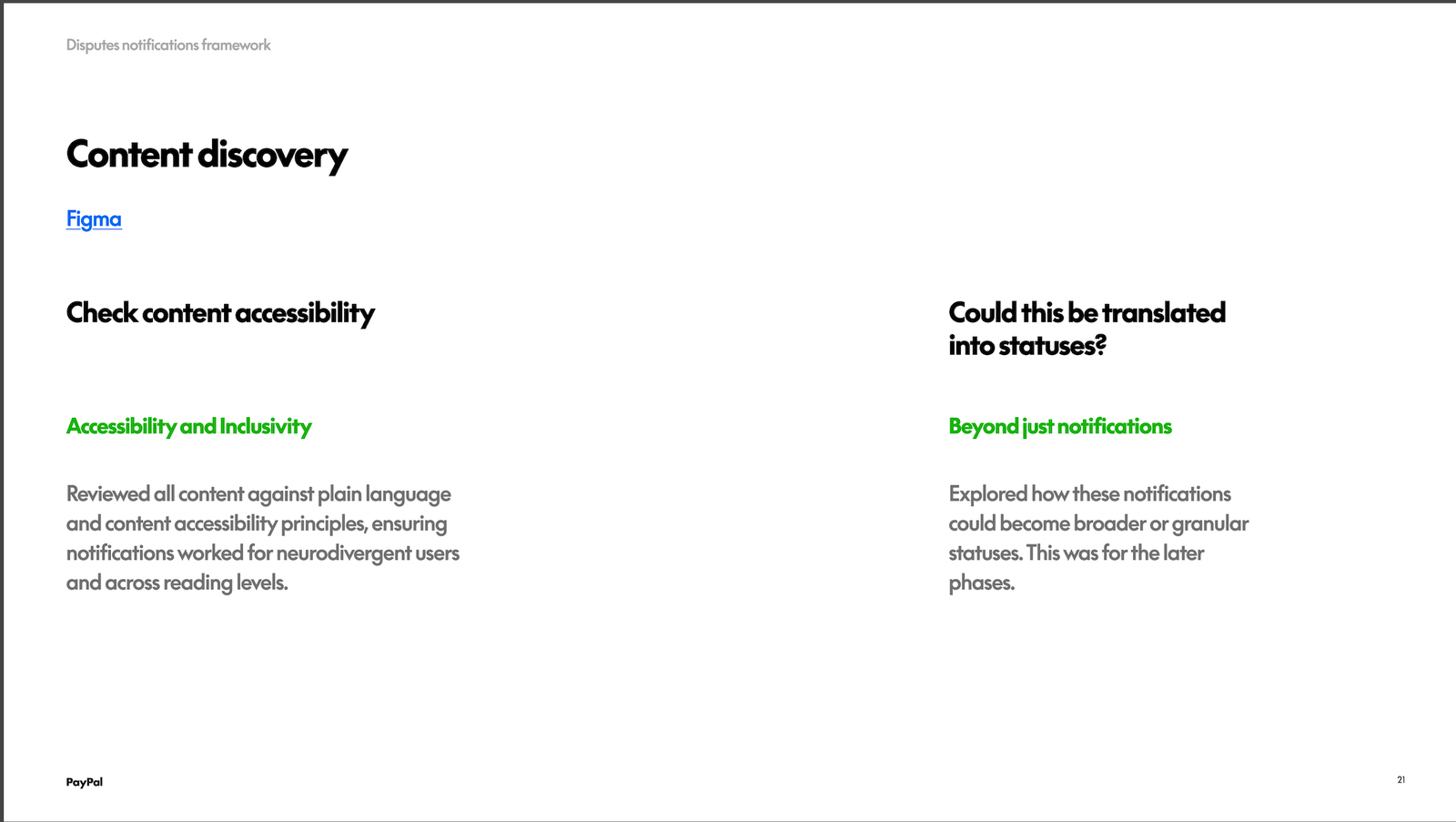
After the initial discovery phase, I wanted to come up with the jobs to be done. This way I was able to structure my work process and stay focused.
This exercise also helped in having a holistic picture of the project.
Approach:
After laying out all the use cases, I noticed this project scope was much bigger than just coming up with content for all the use cases. I vetted the use cases across the channels and from my conversation with engineers and backend team, it was clear that not all use cases were feasible.
This narrowed down to two important questions:
1. How are we going to communicate all of the use cases?
2. As a content designer, how can I create a framework so that I’m not simply writing content for a bunch of use cases but ensuring this can be scaled in future.
Content and experience strategy:
This exercise may seem pretty straightforward. However, a notification in disputes mean a lot to our users. Money is on hold, and users are anxious. Unlike an email, FAQ, or a designated UI page, we have limited characters and word count to communicate to our users in channels like SMS, push and bell.
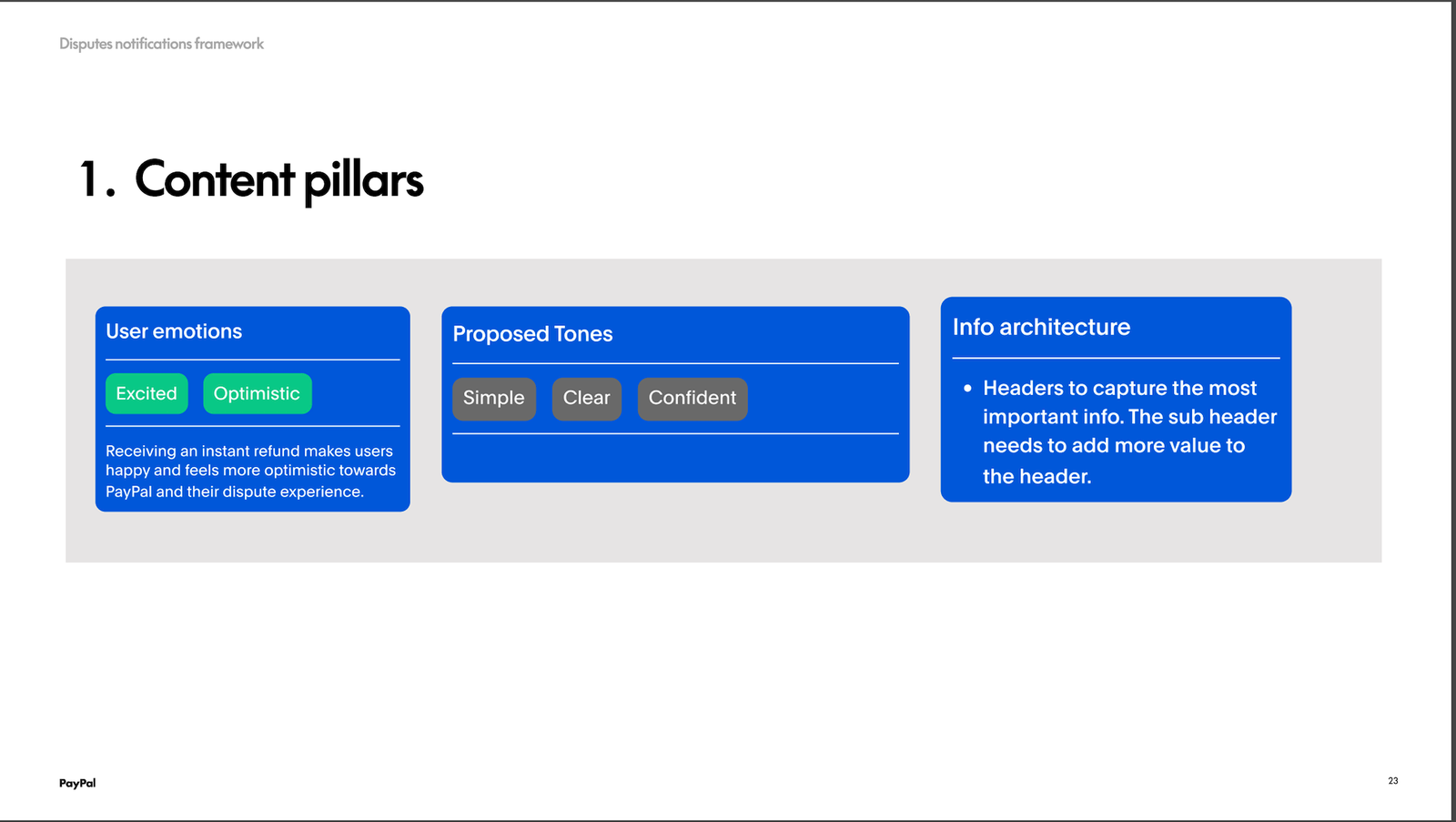
Hence, I came up with the three content pillars which formed the core experience and content strategy for the notifications. I also tried to understand how often users are going to be bombarded by the same messages in three different channels that resulted in having designated rules. This shaped the way were driving the experience.
I also learned that the notifications team had revamped the designs and it was important that we adopt them for the new use cases.
The framework:
All the notifications together drove a pattern.
They were either:
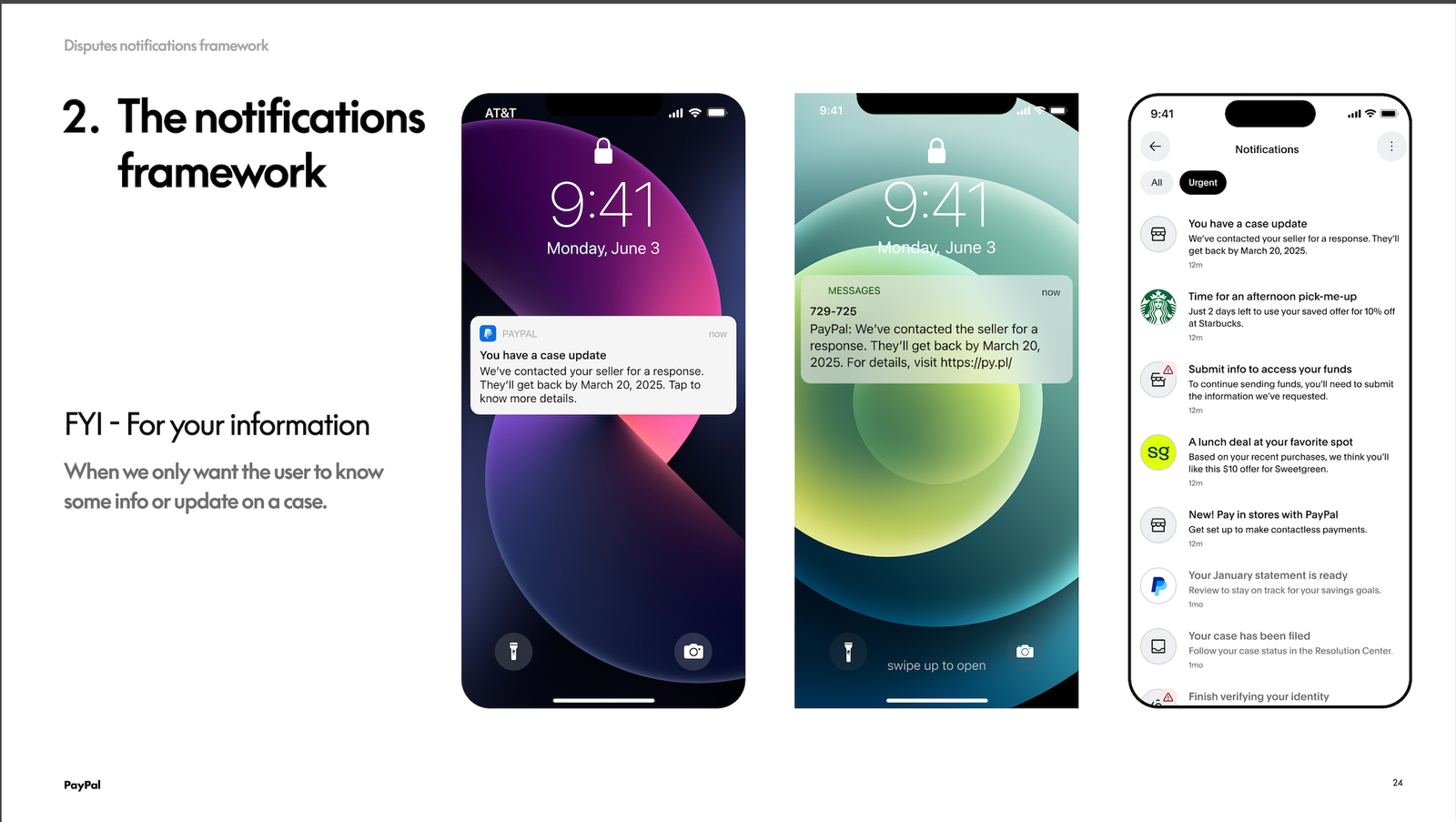
1. Letting the user know something’s progress like an update – FYI (For your information)
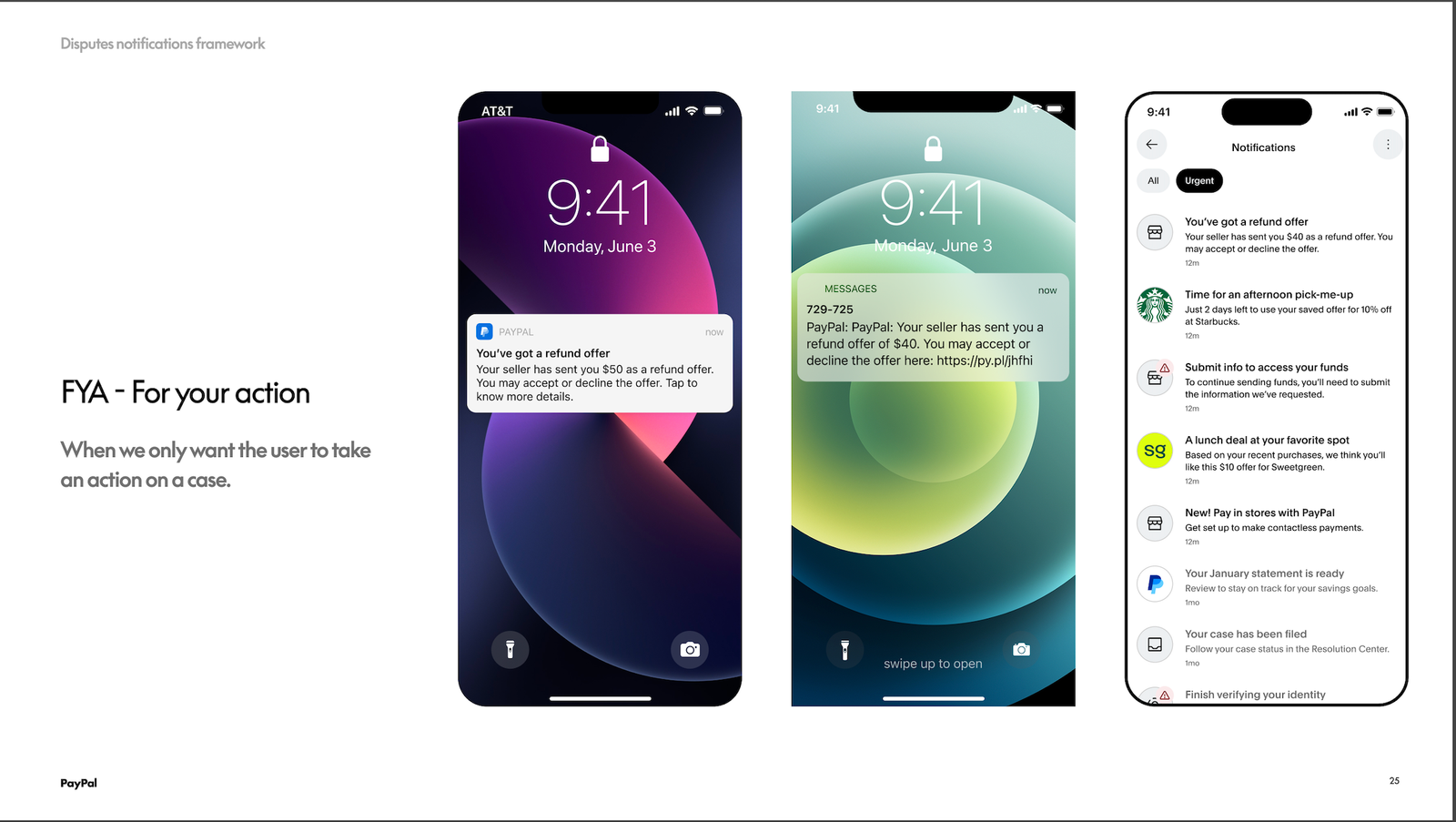
2. Asking them to take an action (For your action)
Benefits:
1. Each notification either shares an update or asks for an action, so people always know why they’re hearing from us.
2. Channel rules meant the same update no longer reached someone three times across push, SMS, and bell.
3. This framework is extremely scalable. Teams can place a new scenario into the pattern and write it to the pillars, instead of drafting it alone.
4. Messages written by different teams now follow the same structure, which also gave legal and localization one consistent pattern to review.
The framework gave every message a purpose, and it outgrew the brief. In under six months, products beyond our platform team had adopted it. Eventually the FYI-FYA notifications framework became the standard messaging strategy and was acknowledged by leadership from Design and Product. Within six months, teams beyond Disputes had adopted the framework.
Early signs showed a small drop in status-related contacts. This was at a ramp of 50%, and it gave us the confidence to go ahead in designing granular level statuses.